Updated November 18, 2026. Indicative score. Weights: entertainment 11.73% (destinations and venues, rings up to 100 km); bars 3.73%; safety 15% with a penalty; water at country level; land price per m² = official source (ITBI, Terracap, registries, valuations) or listings with a caveat · coverage 100%
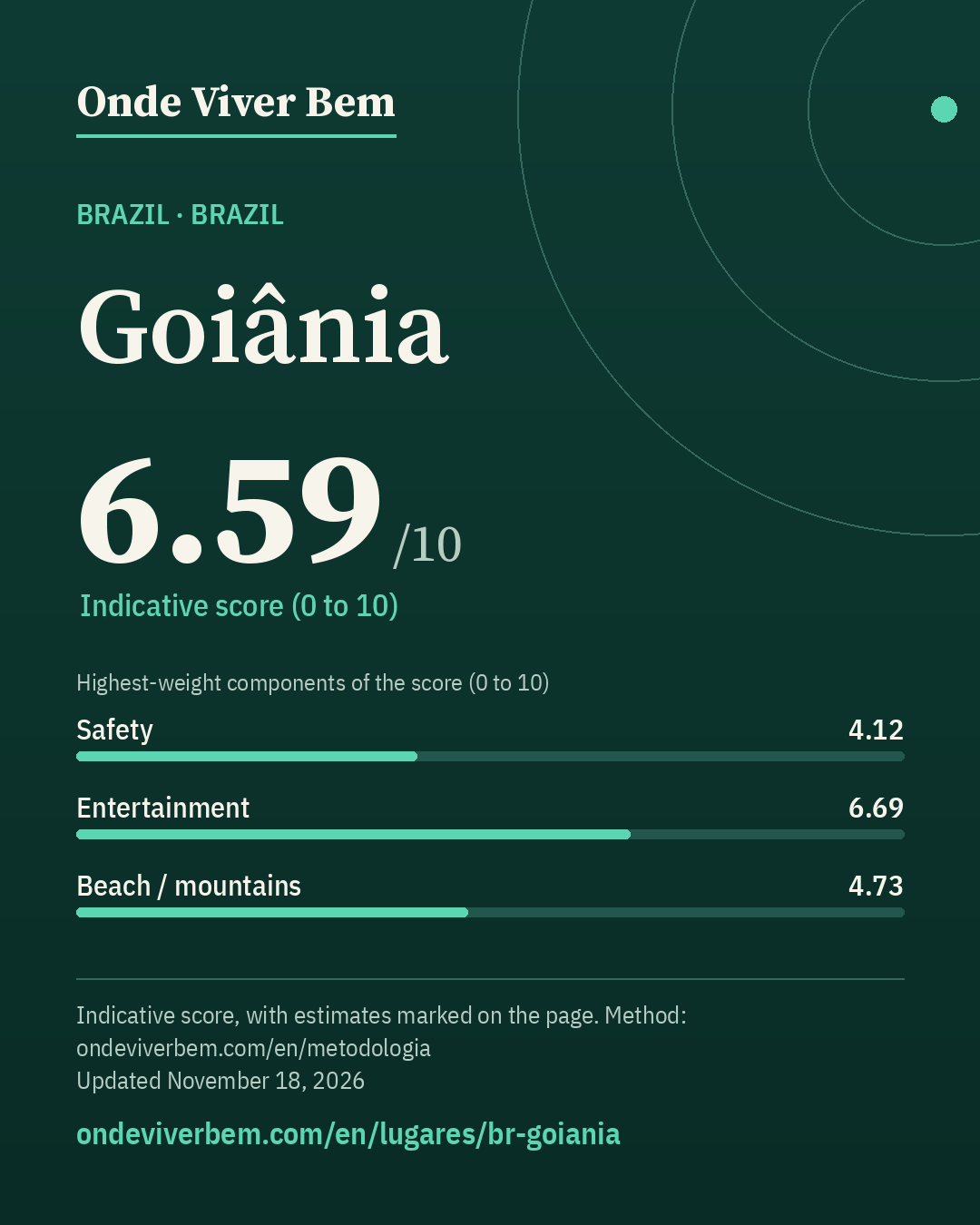
Goiânia has an indicative score of 6.59/10 in the Brazil ranking of Onde Viver Bem, updated November 18, 2026. The strongest published variables are Airport (10.00), Sun (9.38) and Water (8.86); the weakest are Bars (4.09), Safety (4.12) and Beach / mountains (4.73). The scores are indicative. Cost of living is not part of the score. The published land price per m² is R$ 833/m² (listing); that price is not part of the score. Some figures on this page are estimates and carry the “estimated” badge.
raw: 25.76 per 100k pop. · 40% violent deaths (log 30→0, 0.5→10 per 100k) + 30% city robbery ÷ country average (log 5×→0, 0.5×→10) + 30% share who feel safe at night (lin 30%→0, 95%→10); any part without data: weights renormalized
Composite safety: violent deaths 25.8 per 100k → 0.4 (weight 40%) · robbery 0.20× the country average (municipality of Goiânia, jan–set 2024) → 10.0 (weight 30%) · 51.0% feel safe walking alone at night (Brazil (national), 2024) → 3.2 (weight 30%).
raw: 30.0 km · beach: log distance 5 km→10, 150 km→0, searched up to 100 km since 2026-11-12 (before, up to 60 km); mountains: richness of nature leisure (mean of the top 3 of 4 counts, 50 km) × access (1 up to 15 km → 0 at 150 km, log), 0 without relief; score = min(10, max(beach, mountain) + 0.3·min)
100 km radius (2026-11-12): beach within 30 km (includes lake/river) → beach 4.73; mountains 0.00; score 4.73 (before 4.73).
raw: 113.0 count of OSM objects · 50% log1p(count within 2 km), 60→10 + 50% log1p(per 10k pop.), 15→10 · since 2026-11-12: 60% this local score + 40% a regional score up to 100 km (rings 0–30/30–60/60–100 km weighted 1/0.5/0.2; count and density per inhabitant; METODOLOGIA §25)
100 km radius (2026-11-12): 1,338 parks at 0–30 km, 273 at 30–60 km and 219 at 60–100 km (OSM, ohsome 2026-07-27); weighted 1/0.5/0.2 = 1,518 = 1,518; weighted population 3,250,850 (GHS-POP 2025) → 4.67 per 10k people. Regional score 7.96. Local score 8.62 (weight 60%) and regional 7.96 (weight 40%) → 8.36.
raw: 5388.0 active businesses (CNPJ) · Average of two mapping sources, OpenStreetMap and Overture Maps (Overture count ÷ K, K = median Overture/OSM ratio across the 39 cities: 2.57 within 2 km, 3.41 in the municipality); each source: 50% log1p(count within 2 km), 1000→10 + 50% log1p(per 10k pop.), 30→10. Brazil: 50% of that score + 50% log1p(CNPJ per 10k pop. ÷ K), 30→10 · since 2026-11-12: 60% this local score + 40% a regional score up to 100 km (rings 0–30/30–60/60–100 km weighted 1/0.5/0.2; count and density per inhabitant; METODOLOGIA §25)
100 km radius (2026-11-12): 213 restaurants at 0–30 km, 26 at 30–60 km and 79 at 60–100 km (OSM, ohsome 2026-07-27); weighted 1/0.5/0.2 = 242 × OSM completeness factor 2.05 (Overture in the municipality) = 495; weighted population 3,250,850 (GHS-POP 2025) → 1.52 per 10k people. Regional score 4.83. Local score 5.02 (weight 60%) and regional 4.83 (weight 40%) → 4.94.
raw: 26.6 destinations + venues weighted by distance (rings up to 100 km) · 50% log1p(weighted count), 110→10 + 50% log1p(per million people in the region, GHSL), 32.0→10; rings 0–30/30–60/60–100 km weighted 1/0.5/0.2 (since 2026-11-12; before: count within 50 km, 120→10)
100 km radius (2026-11-12): 24 destinations and venues at 0–30 km, 4 at 30–60 km and 3 at 60–100 km (OSM, ohsome 2026-07-27); weighted 1/0.5/0.2 = 27 = 27; weighted population 3,250,850 (GHS-POP 2025) → 8.18 per million people. Regional score 6.69.
raw: 1426.0 active businesses (CNPJ) · Average of two mapping sources, OpenStreetMap and Overture Maps (Overture count ÷ K, K = median Overture/OSM ratio across the 39 cities: 2.48 within 2 km, 3.20 in the municipality); each source: 50% log1p(count within 2 km), 500→10 + 50% log1p(per 10k pop.), 10→10. Brazil: 50% of that score + 50% log1p(CNPJ per 10k pop. ÷ K), 10→10 · since 2026-11-12: 60% this local score + 40% a regional score up to 100 km (rings 0–30/30–60/60–100 km weighted 1/0.5/0.2; count and density per inhabitant; METODOLOGIA §25)
100 km radius (2026-11-12): 58 bars at 0–30 km, 17 at 30–60 km and 10 at 60–100 km (OSM, ohsome 2026-07-27); weighted 1/0.5/0.2 = 68 × OSM completeness factor 2.50 (Overture in the municipality) = 171; weighted population 3,250,850 (GHS-POP 2025) → 0.53 per 10k people. Regional score 3.87. Local score 4.23 (weight 60%) and regional 3.87 (weight 40%) → 4.09.
raw: 76.023 years · average: life expectancy lin 70→0, 85→10; Brazil: beds/10k pop. lin 0→0, 50→10; World: OSM hospitals within 10 km log1p 50→10
Clean airestimated · score 7.49 · weight 4.14%
Estimate: ESTIMATE (not a measurement): the city has no station in the WHO air quality database. Brazil's national average (World Bank, 2023: 13.38 µg/m³) × the city÷Brazil ratio of satellite-derived PM2.5 in the municipality (AQLI/University of Chicago, ACAG/Washington University in St. Louis data, 2023: 11.36 in the city ÷ 12.14 in Brazil, population-weighted = 0.936) = 12.5 µg/m³. Range 12.5–14.3 = same calculation with each year's ratio from 2019 to 2023. AQLI's satellite series excludes mineral dust and sea salt, so we only use the city-to-country ratio, not the absolute value.
raw: 29.0 count of OSM objects · log1p(count), 150→10 · since 2026-11-12: 60% this local score + 40% a regional score up to 100 km (rings 0–30/30–60/60–100 km weighted 1/0.5/0.2; count and density per inhabitant; METODOLOGIA §25)
100 km radius (2026-11-12): 40 cultural venues at 0–30 km, 7 at 30–60 km and 12 at 60–100 km (OSM, ohsome 2026-07-27); weighted 1/0.5/0.2 = 46 = 46; weighted population 3,250,850 (GHS-POP 2025) → 1.41 per 100k people. Regional score 5.12. Local score 6.78 (weight 60%) and regional 5.12 (weight 40%) → 6.12.
The city
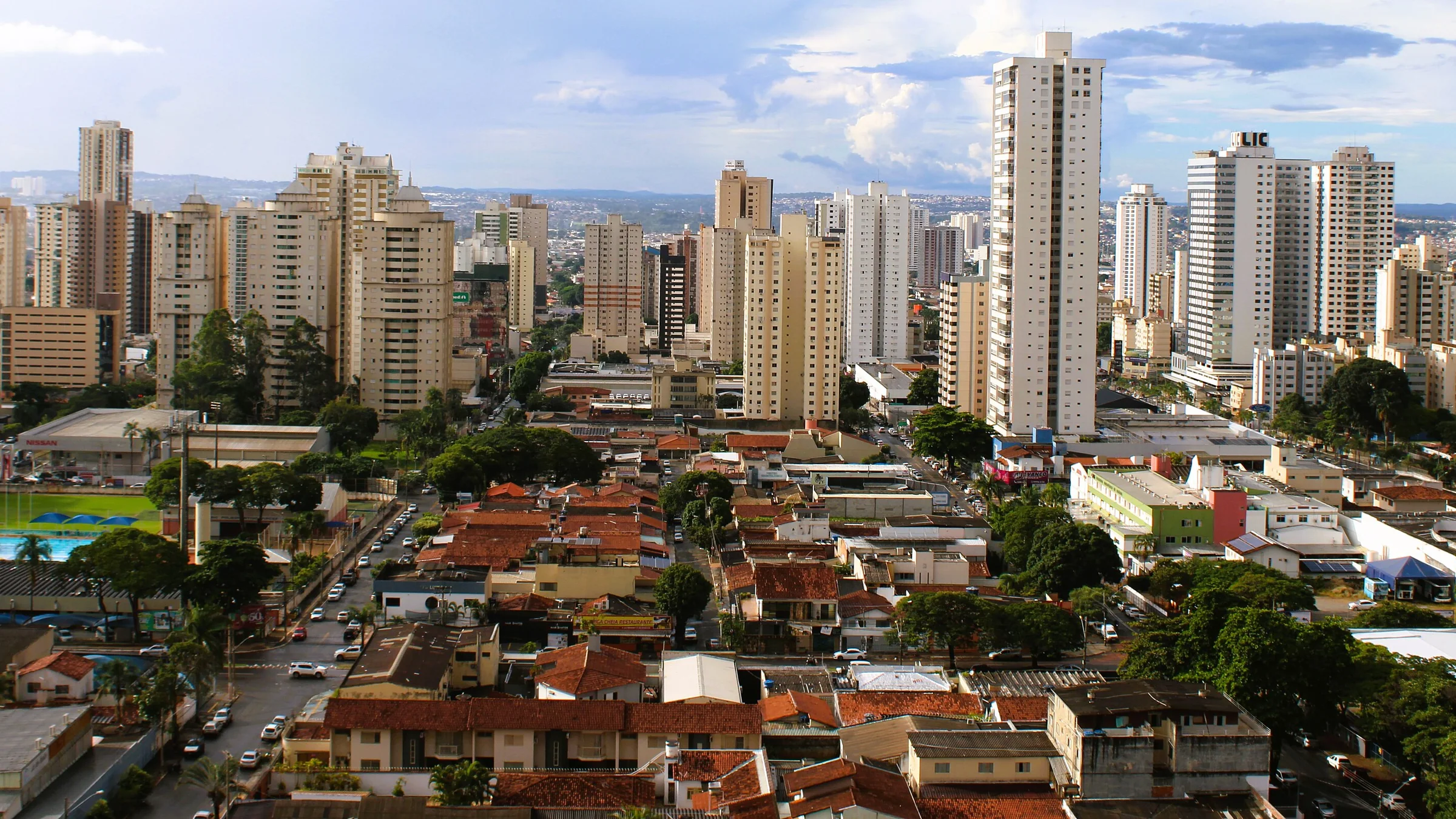
Goiânia is the capital of the Brazilian state of Goiás. It is about 209 km from Brasília, the federal capital, has an area of approximately 728.296 km² and a continuous geography, with few hills and lowlands, typical of a region of Brazil's Central Plateau. It is formed by two urban cores: the seat district and the district of Vila Rica.
English rendering of the Portuguese Wikipedia summary linked below. Source: wikipedia_pt. Wikipedia revision 73420463 (2026-11-11T04:19:49Z).
Taxation
ITBI; no official local rate collected yet (we do not invent the figure). GAP: rate found only in secondary sources (sometimes conflicting); to be confirmed in the law or on the city's page
IPTU; no official local rate collected yet (we do not invent the figure). GAP: progressive tables by assessed value/use; to be collected from municipal law
Frequently asked questions
What is the Onde Viver Bem score for Goiânia?
Goiânia has an indicative score of 6.59/10 in the Brazil ranking, updated November 18, 2026. Cost of living is not part of the score.
What are the strengths and weaknesses of the score for Goiânia?
The strongest published variables are Airport (10.00), Sun (9.38) and Water (8.86); the weakest are Bars (4.09), Safety (4.12) and Beach / mountains (4.73).
Does cost of living or the land price per m² enter the score?
No. Cost of living and the land price per m² appear on the page but are not part of the score. See the methodology.
How is the score calculated?
It is an indicative 0–10 quality-of-life index, with 13 variables and published weights. Safety has a 15% weight and, when local data exist, a lethal-violence penalty may cap the total. The full method is on the methodology page.
Are any figures on this page estimates?
Yes. Some values are documented estimates, labelled with the “estimated” badge in the technical notes. The method is explained in the Estimates section.
Download the image and post it to your feed, story or video. To send people to the site, use the link sticker in your story or the link in your bio (links in captions are not clickable).
Informational content and indicative scores. This is not advice on investing, immigration, buying property or choosing a career. Every metric cites its source; cost of living is not part of the score.